Γράφει η Δρ Παναγιώτα Αξελιθιώτη, επιστημονική σχολιαστής με ειδίκευση στην κριτική σκέψη και τις φυσικές επιστήμες
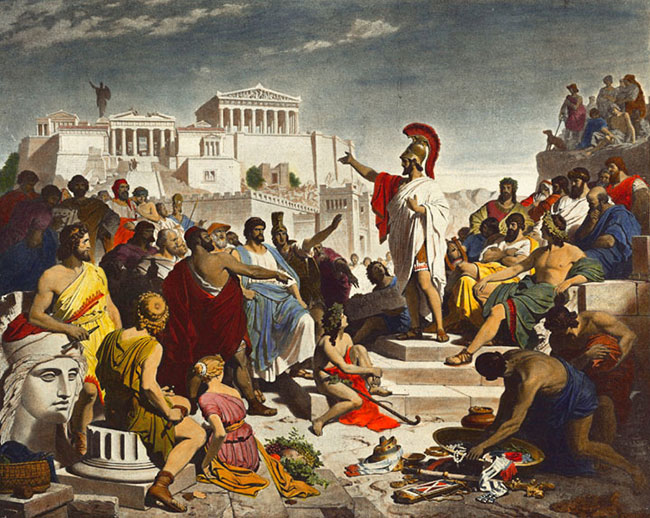
Οι αρχαίοι Έλληνες μαζεύονταν στην Αγορά για να μιλήσουν για τα κοινά, να διαφωνήσουν (κάποιοι, όχι όλοι), να ρητορεύσουν και να επιδείξουν με τη γνώση και τη σοφία τους ότι υπήρχαν επιχειρήματα και οφέλη να πράξει η Αγορά προς τη μία κατεύθυνση ή την άλλη. Ρήτορες (Liddell&Scott, 2007) υποστήριζαν και αντικρουώμενες απόψεις καταπώς είχαν θεωρήσει την πτυχή που υποστήριζαν. Αυτούς που ρητόρευαν κατά το συμφέρον τους όμως και παραπληροφορούσαν τους συμπολίτες τους, τους μάθαμε στην ιστορία ως δημαγωγούς (δήμος+άγω = οδηγεί το λαό)με αρνητική έννοια, δημοκόπους ή λαοπλάνοους (Liddell&Scott, 2007). Ο δημαγωγός παρουσίαζε μια πραγματικότητα ωραιοποιημένη προς την κατεύθυνση που ήθελε να επηρεάσει την κοινή γνώμη και προσδοκούσε να επικρατήσει ο λαϊκισμός και το λαϊκό συναίσθημα (όχι αίσθημα) πάνω από τη λογική. Οι ρήτορες, αντίθετα με τους δημαγωγούς, ρητόρευαν με γνώμονα τη λογική, τη βαθιά και κριτική σκέψη και την (μάλλον προσωπική τους) ανάγκη να διακρίνουν την ευρύτερη αλήθεια, μέρος της οποίας ήταν η όποια παρούσα πραγματικότητα. Το δημόσιο βήμα, αν και ανοιχτό προς όλους, ήταν μια πρόκληση. Ναι μεν η αγορά ήταν πρόθυμη να ακούσει, αλλά αν δεν είχε ο ομιλητής δυνατό λόγο, δυνατό επιχείρημα και ρητορική ικανότητα, η ανταπόκριση της Αγοράς ήταν έντονη αποδοκιμασία που εκδηλωνόταν με δυσάρεστο τρόπο. Ο σκοπός ήταν το βήμα να ντροπιάζει και να αποθαρρύνει τους απροετοίμαστους και να εξυψώνει τους ρήτορες ή δημαγωγούς. Αυτή η πρακτική αναδείκνυε την ατομική και τη συλλογική ευθύνη και των ρητόρων αλλά και της Αγοράς. Ναι, ο ρήτορας όφειλε να είναι προετοιμασμένος για το λόγο του, αλλά και το ακροατήριό του καλούνταν να ασκήσει λογική και κριτική σκέψη, να ζυγιάσει και να υπολογίσει τα οφέλη της πρότασης για το ευρύτερο καλό, την ευημερία και τον πολιτισμό.
Υπήρχε και μία άλλη ορολογία με ενδιαφέρουσα έννοια στην αρχαία Ελλάδα, ο ιδιώτης. Ο ιδιώτης σύμφωνα με το λεξικό της Αρχαίας Ελληνικής Γλώσσας ήταν αυτός που ήγαγε ιδιωτική ζωή, ζωή μέσα στο σπίτι, ο «ανειδίκευτος», ο ανίδεος (Liddell&Scott, 2007). Ο ιδιώτης δεν ήταν ο πολίτης που θα συνέβαλε στη διαμόρφωση της κοινής γνώμης, λάμβανε κατώτερη μόρφωση (αν λάμβανε).Η απόδοση της λέξης ιδιώτης στην αγγλική γλώσσα «idiot» σήμερα σημαίνει αδαής, για να είμαστε πιο σαφείς, χαζός (Merriam-Webster, 2020) και προέρχεται από την αντίστοιχη ελληνική και ως προς τη μορφολογία (είναι η ίδια λέξη με λατινικούς χαρακτήρες) και ως προς την αρχαία ελληνική έννοια (ο κοινός άνθρωπος, ο αμόρφωτος, αυτός που δεν αναλαμβάνει κοινωνικό αξίωμα).
Τη γνώμη μου είπα!
Σήμερα έχουμε κοινωνίες οργανωμένες πάνω στα πρότυπα της αρχαίας ελληνικής κοινωνίας αλλά οι δομές είναι πιο πολύπλοκες, οι πληθυσμοί πολύ μεγαλύτεροι και η Αρχαία Αγορά δεν υπάρχει. Η ανταλλαγή απόψεων πέρασε από το καφενείο, την καφετέρια και το εστιατόριο,στοForum (λατινική λέξη που σημαίνει αγορά), δηλαδή διαδικτυακοί τόποι για συζήτηση και ανταλλαγή απόψεων πάνω σε συγκεκριμένα θέματα, π.χ. τον ποδηλατισμό, τη μητρότητα, μια ασθένεια, μια ομάδα στήριξης, κ.ο.κ. Υπάρχουν επίσης τα κοινωνικά δίκτυα τα οποία ξεκίνησαν με χαρακτήρα δικτύωσης και επαφής σε προσωπικό επίπεδο (νέα, φωτογραφίες, βίντεο κτλ) σε διαδικτυακούς χώρους όπου ο κόσμος μοιράζεται πέρα από προσωπικές πληροφορίες (κατά προτίμηση πάντα) και ιδεολογίες, άρθρα, ειδήσεις από τον κόσμο, κοινωνικό, πολιτικό, οικολογικό, και οικονομικό γίγνεσθαι. Με άλλα λόγια οι δυνατότητες είναι απεριόριστες. Τα κοινωνικά δίκτυα με αυτήν τους τη δυναμική έχουν επαναφέρει τ οενεργό βήμα της Αρχαίας Αγοράς και πλέον είναι χώροι ανταλλαγής πληροφοριών με μεγάλη απήχηση και τη δυνατότητα διαμόρφωσης κοινωνικής συνείδησης (π.χ. Parketal., 2009; Porten-Cheé &Eilders, 2015). Πώς; Πολύ απλά με το να συνδέουν τους ανθρώπους σε έναν ευρύ διαδικτυακό τόπο που αψηφά όλους τους περιορισμούς χώρου, χρόνου, και γλώσσας και μεταδιδεί μηνύματα και νέα προς όλον τον πλανήτη που είναι δικτυωμένος. Πραγματικά χρήσιμη τεχνολογική εξέλιξη. Όλοι μπορούμε να πάρουμε το βήμα, να πούμε τη γνώμη μας, να παραθέσουμε έρευνα, να αναφερθούμε σε επιχειρήματα που θα στηρίξουν και θα εγκυρώσουν τη γνώμη μας. Κι έτσι δε θα είναι πλέον μόνο γνώμη, θα είναι ένα σημείο αναφοράς.
Ας θυμηθούμε όμως την πρακτική της Αρχαίας Αγοράς όταν αδύναμοι ομιλητές ανέβαιναν στο βήμα και ας αναλογιστούμε για μια στιγμή τι μπορεί να θέλουμε να πούμε από το κοινωνικής-δικτύωσης βήμα μας, πως μπορούμε να το πούμε και πότε θα είναι σημείο αναφοράς. Με λίγα λόγια γιατί θέλουμε να ανεβούμε σε αυτό το βήμα και αυτό που θέλουμε να πούμε σε τι αποσκοπεί; Και το πιο σημαντικό ποια ατομική και συλλογική ευθύνη είμαστε ο καθένας πρόθυμοι να αναλάβουμε για αυτό που θα πούμε; Ατομική και συλλογική ευθύνη. Μεγάλες κουβέντες που ίσως έχουν ξεχαστεί. Δηλαδή; Η ευθύνη σύμφωνα με το λεξικό είναι η ανάληψη των συνεπειών μιας πράξης που επιλέγω να κάνω (Τριανταφυλλίδης, 2020). Η ατομική ευθύνη αφορά το άτομο. Συνήθως και οι επιπτώσεις αφορούν το άτομο. Η συλλογική ευθύνη αφορά το σύνολο, το κοινωνικό (ή άλλο) πλαίσιο στο οποίο επιλέγουμε να κάνουμε μια πράξη. Σε ένα κοινωνικό μέσο δικτύωσης οι έννοιες της ατομικής και συλλογική ευθύνης παρόλα αυτά παρουσιάζουν μία ιδιομορφία. Είναι αλληλένδετες. Διότι παρόλο που είναι η κοινωνική δικτύωση είναι μια αυτοέκφραση (άρα ατομική ευθύνη) όταν αναφέρεται σε κοινωνικά φαινόμενα (οικονομία, οικολογία, υγεία, πολιτική, δημόσια ζωή, κτλ) παρόλο που εκφράζεται ατομικά γίνεται συλλογική όταν αποσκοπεί να επηρεάσει την κοινή γνώμη, να ενημερώσει, να μεταδώσει γνώση ή να παραπληροφορήσει. Αυτή είναι και η ισχύ του κοινωνικού δικτύου ως βήμα. Αν θέλω να επηρεάσω τον κόσμο προς μία κατεύθυνση μπορώ. Τα λόγια μου μπορούν να αναπαραχθούν, οι πράξεις μου, οι φωτογραφίες μου, οι βιντεοσκοπήσεις μου μπορούν να φτάσουν σε όλες τις δικτυωμένες άκρες της γης. Και έτσι η ατομική μου αυτοέκφραση αποκτά συλλογική ευθύνη.

Σε όλη σχεδόν τη διάρκεια του 2019 γίναμε μάρτυρες των συλλογικών ειρηνικών διαδηλώσεων για την προστασία του περιβάλλοντος και του πλανήτη, μάθαμε το όνομα και το πρόσωπο της Γκρέτα Τούνμπεργκ, εκατοντάδες χιλιάδες κόσμος παρακολούθησε εκατοντάδες χιλιάδες κόσμο να σηκώνει αυτοσχέδια πανό για να πιέσει κυβερνήσεις και πολυεθνικές. Και μετά ο κόσμος ησύχασε γιατί εμφανίστηκε ένας επικίνδυνος ιός. Η ησυχία όμως μόνο στους δρόμους, γιατί στα κοινωνικά δίκτυα η φασαρία, οι απόψεις και η πολυφωνία περίσσεψαν. Το πιο ανησυχητικό φαινόμενο σε αυτήν την πολύφωνη κακοφωνία των κοινωνικών δικτύων είναι ότι ο κόσμος συγχέει τι είναι γνώμη, άποψη, προσωπική οπτική και τι είναι πληροφόρηση, εμπεριστατομένη έρευνα, λογική απάντηση στο συναίσθημα (όχι αίσθημα) που προκαλεί η ησυχία στους δρόμους. Δυστυχώς ακούμε περισσότερες γνώμες παρά διαβάζουμε εμπεριστατομένες μελέτες. Γιατί όμως; Τι είναι αυτό που αποπροσανατολίζει; Κυρίως το γεγονός ότι έχουμε συνηθίζει πλέον να ανεβαίνουμε στο βήμα χωρίς να αναλαμβάνουμε ευθύνη. Σκεφτείτε για ένα λεπτό τι έγραψα στην εισαγωγή: οι ρήτορες είχαν την ανάγκη να εκφράσουν την αλήθεια στην οποία είχαν καταλήξει μέσα από σκέψη, βαθιά και κριτική, μέσα από ανταλλαγή απόψεων, όπου άκουγαν και έλεγχαν τον αντίλογο. Στα κοινωνικά δίκτυα όμως έχουμε τη δυνατότητα να επιλέγουμε να ακούμε μόνο όμορες γνώμες τονίζω γνώμες όχι πληροφορίες και δεδομένα.Γιατί με αυτήν τη ρηχή και γρήγορη επιβεβαίωση αυτόματα, γρήγορα και χωρίς πολύ ψάξιμο η γνώμη μας γίνεται σημείο αναφοράς (αφού το λέει και ο τάδε, και οι χίλιοι τάδε, άρα είναι αλήθεια…λένε και αυτοί που διατείνονται ότι η γη είναι επίπεδη). Εσυ πιστεύεις ότι η γη είναι επίπεδη; Πριν γίνουμε σημεία αναφοράς ΝΑ ΣΚΕΠΤΟΜΑΣΤΕ, με υπευθυνότητα, με κριτική, με λογική. Πώς; Η κριτική σκέψη (το αγαπημένο μου αντικείμενο και η ειδίκευσή μου) είναι μία διαδικασία προς τη διαμόρφωση ορθής και εμπεριστατομένης γνώμης. Ναι για τη διαμόρφωση γνώμης. Η διαφορά της κριτικής σκέψης και της απέδευτης, ρηχής γνώμης είναι η επιχειρηματολογία που στηρίζει την πρώτη και αδειάζει τη δεύτερη. Συγκεκριμένα η κριτική σκέψη απαιτεί να πεδέψουμε το μυαλό μας, να μπούμε ενσυνείδητα στη διαδικασία να αναλογιστούμε δύο ή περισσότερες πτυχές ενός συμβάντος, φαινομένου, γεγονότος.Αυτό απαιτεί αρχικά συγκεκριμένο σκοπό. Ασκούμε την κριτική μας σκέψη γιατί θέλουμε να φτάσουμε στη διαμόρφωση μιας γνώμης που μπορεί να γίνει σημείο αναφοράς, για την οποία έχουμε κάνει μια μελέτη, έχουμε εκτεθεί σε διαφορετικές πτυχές, την καθεμία από τις οποίες την έχουμε αξιολογήσει σύμφωνα με κάποια κριτήρια, σταθερά και επαναλαμβανόμενα:
- είναι η πηγή ενημέρωσης αξιόπιστη;
- είναι τα δεδομένα αρκετά προς μία πτυχή;
- είναι αυτά που διαβάζω/ακούω δεδομένα ή απλά γνώμες;
- είναι αυτά που διαβάζω/ακούω σχετικά με την αρχική μου αναζήτηση;
- τα κατάλαβα ή χρειάζομαι κάποιον με ειδικότερη γνώση να μου τα εξηγήσει;
- είμαι διατεθιμένος να ακούσω και τα αντικρουώμενα επιχειρήματα και να τα αξιολογήσω χωρίς προκατάληψη; (βασισμένο στον ορισμό του American Philosophical Association, Facione, 1990)
Αυτή η διερώτηση προς εαυτόν αλλά και προς τις πληροφορίες που λαμβάνουμε σταματάει ουσιαστικά όταν φτάνουμε σε ένα σημείο που στην επόμενη επανάληψη αυτών των ερωτήσεων θα λάβουμε απαντήσεις που ήδη γνωρίζουμε. Αυτό λέγεται κορεσμός πληροφόρησης. Ο McPeck (1981), ο πιο αμφιλεγόμενος ίσως από τους μελετητές της κριτικής σκέψης, έγραψε ότι οι κριτικά σκεπτόμενοι δε νιώθουνε άνετα στην πρακτική και την άσκηση της κριτικής σκέψη μέχρι να αποκτήσουν ένα επίπεδο ειδίκευσης. Αυτό δε σημαίνει ότι όλοι θα γίνουμε ειδικοί σε όλα. Σημαίνει, όμως, ότι έχουμε τη δύναμη και τη δυνατότητα να δεχόμαστε και να παραδεχόμαστε πού δεν είμαστε καλά ενημερωμένοι και είτε να ξεκινάμε μία διερεύνηση είτε να εμπιστευόμαστε αυτούς που έχουν ειδικευθεί και πεδευθεί. Ακόμα και τότε, οι ειδικοί εμπίπτουν σε λάθη. Τα λάθη είναι ανθρώπινα και ένας ειδικός που θα παραδεχτεί δημόσια το λάθος του αξίζει το βήμα. Τα λάθη όμως που εμπίπτουν στην εμπάθεια, στο συναίσθημα (συνήθως με το παραπέτασμα της αγανάκτησης που είναι και κολλητική) και στον λαϊκισμό έχουν χαρακτήρα ατομικής και συλλογικής ανευθυνότητας. Γιατί όταν επικροτούν και ενθαρρύνουν πραξεις κοινωνικής ανευθυνότητας (τι πειράζει ένα σκουπίδι στο δρόμο; Είπαν όλοι οι Θεσσαλονικείς και οι δρόμοι έγιναν σκουπιδότοποι) τότε καταπατούν τις ελευθερίες όλων μας. Όχι, μη λες απλά τη γνώμη σου ιδιαίτερα όταν ο κόσμος βρίσκεται σε κρίση. Η πολυφωνία είναι και οχλαγωγία σε περίοδο κρίσης. Αν δε θέλεις να κάνεις τον κόπο να μάθεις πριν μιλήσεις (βούτα τη γλώσσα σου, μου έλεγαν όταν ήμουν μικρή) σιώπα. Και η σιωπή δείχνει εξυπνάδα. Αν δεν μπορείς να διαβάσεις, αντί για γνώμη κάνε ερώτηση. Ή κάνε τη διερεύνησή σου. Παρέθεσε μια εμπεριστατωμένη γνώμη που εξηγεί με σαφήνεια τι πιστεύεις και γιατί. Σε μία κοινωνική πλατφόρμα μην είσαι «ιδιώτης». Γίνε σημείο αναφοράς. Σεόλουςυγείαςεύχομαι.
Βιβλιογραφία
Facione, P.A. (1990) Critical Thinking: A Statement of Expert Consensus for Purposes of Educational Assessment and Instruction. Research Findings and Recommendations. Newark, NJ: American Philosophical Association, The Delphi Research Group.
Liddell&Scott (2007) Επιτομή του Μγάλου Λεξικού της Ελληνικής Γλώσσας, εκδόσεις ΠΕΛΕΚΑΝΟΣ (διαδικτυακή πηγή). Μπορείτε να το βρείτε: http://www.greek-language.gr/digitalResources/ancient_greek/tools/liddell-scott/index.html
McPeck, J.E. (1981) Critical Thinking and Education. Oxford: Martin Robertson.
Merriam-Webster (2020) Merriam-Webster Dictionary(διαδικτυακήπηγή). Μπορείτενατοβρείτε: https://www.merriam-webster.com/
Park, N., Kee, K. F., & Valenzuela, S. (2009) “Being immersed in social networking environment: Facebook groups, uses and gratifications, and social outcomes.” CyberPsychology& Behavior, 12(6), 729-733.
Porten-Cheé, P., &Eilders, C. (2015) “Spiral of silence online: How online communication affects opinion climate perception and opinion expression regarding the climate change debate.” Studies in communication sciences, 15(1), 143-150.
Τριανταφυλλίδης (2020) ΠύληγιατηνΕλληνικήΓλώσσα (διαδικτυακήπηγή). Μπορείτε να το βρείτε: http://www.greek-language.gr/greekLang/modern_greek/tools/lexica/triantafyllides/search.html
I’m entitled to my opinion – The tribune called Social Network
Introduction
Ancient Greeks gathered in Agora to talk about the commons, disagree (some, not all), orate (in the sense of lecture) and demonstrate with knowledge and wisdom that there were supporting arguments and benefits for the Agora to take one action over another. Orators (Merriam-Webster, 2020) could be arguing and counterarguing with each other according to their study and conception of the stance they were supporting. Those who were preaching driven by personal gain, though were called demagogues (δήμος+άγω = (mis)leading the people) with a negative connotation, provocateurs and inciters. The demagogue presented a beautified reality towards the decision he wanted the Agora to follow, aiming to influence the public opinion and have his preferred plan to prevail by means of populism and triggering public unrest (not emotion) over logic. Orators, on the other hand, lectured with logic, deep and critical thinking driven by the need (probably their own) to reveal the bigger picture to which the current instance for decision belonged. The public tribune, tough open to all, was a challenge. The Agora was willing to listen, but if the speaker did not demonstrate strength of speech, language, argumentation, and rhetoric skill, the response from the audience was both formidable and unpleasant. The purpose was to discourage and shame those who were unprepared and elevate the orators or (sadly) the demagogues. This practice of public speaking demonstrated the individual and shared responsibility both for orators as well as the Agora. The orator ought to be prepared and rehearsed in his delivery but also the audience was expected to evaluate the oration logically and critically, to balance the pros and cons and assess the benefits by the criteria of common good, prosperity and civilization.
Additionally, there was another interesting term, that of idiotis (ιδιώτης). Idiotis according to the Lexicon for the Ancient Greek Language (Liddell & Scott, 2007 – in Greek) was the person that led an individual life, in the home, without skills, ignorant. Idiotis was not the citizen than participated in shaping the common opinion, and was likely to receive low level education if at all. The transference of the word idiotis to the English language, the word idiot, means ignorant and to be more precise a foolish or stupid person (Merriam-Webster, 2020). It is the same word as the Greek one written in Latin characters and its meaning is very similar to the definition of the ancient Greek word (a commoner, uneducated, unable to take on a civil duty).
I’m entitled to my opinion!
Today we live in societies that are organized on the guidelines of the ancient Greek society but the modern-time structures are more complicated, the populations much greater and the ancient Agora doesn’t exist as a practice. The exchange of opinions happens at a community level where numbers are manageable or more recently there are the Fora (from the Latin word forum which means Agora), the online spaces for conversation and the presentation of opinions within a specific context, i.e. bicycling, motherhood, parenthood, a disease, support groups etc. There are also the social networks that originally had the key feature of connecting people across large distances at a personal level (via sharing news, photos, videos, etc). In the social networks people share a lot of personal information (as per individual judgement) along with ideologies, articles and publications, news from around the world, and present the social, ecological, financial and political status quo as they know it in their location. This potent function of social networks has reinstated the tribune of the ancient Agora and they are spaces for exchange of information with far-reaching appeal and the potential to influence and shape public opinion (i.e. Parketal., 2009; Porten-Cheé &Eilders, 2015). How? Merely by connecting people in a wide online platform that defies formerly existing restrictions of place, time and language, so messages, posts, and self-expression can now be disseminated across the globe. A truly useful technological advancement. We can all use this tribune, share our opinion, present research and supporting arguments that validate our opinion. And validation changes the status of our opinion making it a point of reference.
Let’s go back to the practice of the ancient Agora and remember how the weak speakers were booed off the tribune and put our mind to work to figure what we want to disseminate from our social-network-based tribune, how we can phrase it and when it may be a point of reference. In other words why do we want to step up on that public space and what does our message aim to achieve? And most importantly which is the individual and the shared social responsibility that we are each willing to take on onve we make our thoughts public? Individual and shared social responsibility. Big words with heavy meanings, perhaps forgotten. Responsibility according to the dictionary is something that one must do because they have agreed to do it (Merriam- Webster Thesaurus, 2020) otherwise they should be prepared to accept the consequences of their actionor non-action. The individual responsibility concerns the person and usually the consequences are personal as well. The shared social responsibility concerns a social group, community or team and the consequences befall all when taking action (or non-action). In the context of social networks, however, individual and shared responsibility are idiomorphic in the sense that they are intertwined. Social networking is a form of self-expression (thus concerning the individual) that has a wide reach and dissemination in the world on social, political, economic, ecological issues, public life, etc. Although it remains an expression of one individual in the majority of cases it acquires features of shared responsibility when it aims to inform, disseminate information and data, influence the public opinion or even misinform. This is the strength and potency of the social network as a tribune. If I wish to influence the world toward one aspect or another, I have a means to reach out to a large number of people. My words can be shared and reproduced, photos, videos can reach all the connected corners of the earth. And in that manner a self-expression extends to carry shared social responsibility.
During 2019 we bore witness to many loud and peaceful climate marshes, where people protested for the environment and the planet. We learned the name and face of Greta Thunberg and hundreds of thousands of people watched hundreds of thousands of people raise their homemade banners to put pressure on governments and multinational companies. Then the world went quiet as a dangerous virus appeared. The quiet of the streets though did not carry in the venues of social networks where noise and polyphony rose in excess. The most prominent concern in this multifold cacophony of comments and opinions is that social networkers seem unable to tell opinion from fact, personal view from scientific data, thoughts from reliable scientific projections and logic from unrest (not emotion) that the quiet of the streets seems to stir. Unfortunately, we hear, read and watch more opinions than facts and studies and I wonder what the disorienting trap is. Is it the habitual easiness of expressing a view on social media without taking any responsibility for where that leads? Most likely that is the obvious culprit. We publish our self-righteous self-expression without considering the responsibility of the repercussions this opinion may have to those that receive it. We do not act at all as orators who were probably compelled to search, argue and counterargue, and think deeply and critically for the facts before taking to public speaking. In social networks there is layer of protection towards nay-sayers, that being that it is within our choice and power to quiet the opposing opinion, to ban it from appearing in our news and choose instead they yay-sayers, who share similar opinions; opinions not information or facts. This quick and shallow acceptance and often applauding of an opinion gives the latter a make-believe status of point of reference with little effort, exposure to knowledge, and information on the part of the speaker (since so and so, one thousand sos agree, it must be true…claim flat-earthers). Are you a flat-earther? What evidence is there for this claim? Skipping the most crucial part of the process, namely research, does not make an opinion a point of reference. THINK before you speak (people said to me when I was young). Being a point of reference requires responsibility, research, common sense, and critical thinking. Critical thinking (my favourite occupation and the field of my research) is a process for forming a judgement that withstands criticisms using robust supporting argumentation. Indeed it is about forming an opinion. The difference between walking the mile of critical thinking versus blurting out an unthought-through viewpoint is the explanation, evidence and argumentation, which often rebuts the unthought-through viewpoint. Dewey (1933) said we have to allow ourselves to be perplexed about issues, to consciously engage in the exercise of considering different points of view. This requires that we have a specific context within which to form an opinion. We then practice critical thinking and reaching a confident and coherent competence on a matter can transform our opinion to a point of reference. This process requires enough study of own viewpoint and of others, with open-mindedness and keenness to evaluate against preset criteria, analyse and assess information in a repeated process that follows more or less the following key points:
- are the sources of information reliable?
- do I have enough information per viewpoint?
- is the information I have gathered opinions or facts?
- is the information I have gathered relevant to my original context?
- have I understood the information, or do I need some expert guidance?
- am I willing to listen to counter points of view and assess them without conscious bias? (based on the definition of the American Philosophical Association, Facione, 1990).
This line of self-questioning and of questioning the incoming information reaches saturation when upon asking the questions we find no novel information. McPeck (1981), the most controversial scholar of critical thinking, claimed that critical thinkers require a level of confidence which comes with some expertise to embark on the formation of an opinion. That does not signify that we have to be experts in everything rather that we have to have done a certain amount of reading, understanding, explaining and questioning before we form a judgement. Otherwise we should consider learning from the experts who have already gone through the process. Not that experts are free of mistakes, they are not. However, they are likely to admit their mistakes, which makes them brave. On the other hand, when experts try to stir unrest by employing anger (the most contagious of emotions) and resorting to populist techniques, the burden of their shared social responsibility is great and ours is to look for information in more reliable sources. When experts encourage actions of irresponsibility and social unrest (it’s just one straw said 8 billion people) they trample human freedoms, abuse the tribune and are demagogues. No, don’t express your opinion, if it contributes nothing, especially during a time of crisis. Irresponsible polyphony causes irrational uproar. When unwilling to take the time and make the effort to substantiate your opinion, THINK before you talk and opt to not talk. Or do the work and TALK responsibly, present a well-supported opinion which you can explain. In a social platform don’t be an idiotis. Be a point of reference.
References
Dewey, J. (1933) How We Think: A restatement of the relation of reflective thinking to the educative Process. Boston, MA: D. C. Heath.
Facione, P.A. (1990) Critical Thinking: A Statement of Expert Consensus for Purposes of Educational Assessment and Instruction. Research Findings and Recommendations. Newark, NJ: American Philosophical Association, The Delphi Research Group.
Liddell&Scott (2007) Επιτομή του Μγάλου Λεξικού της Ελληνικής Γλώσσας, εκδόσεις ΠΕΛΕΚΑΝΟΣ (διαδικτυακή πηγή). Μπορείτε να το βρείτε: http://www.greek-language.gr/digitalResources/ancient_greek/tools/liddell-scott/index.html
McPeck, J.E. (1981) Critical Thinking and Education. Oxford: Martin Robertson.
Merriam-Webster (2020) Merriam-Webster Dictionary& Thesaurus(online source). Available at: https://www.merriam-webster.com/
Park, N., Kee, K. F., & Valenzuela, S. (2009) “Being immersed in social networking environment: Facebook groups, uses and gratifications, and social outcomes.” CyberPsychology& Behavior, 12(6), 729-733.
Porten-Cheé, P., &Eilders, C. (2015) “Spiral of silence online: How online communication affects opinion climate perception and opinion expression regarding the climate change debate.” Studies in communication sciences, 15(1), 143-150.
 Vaterlo